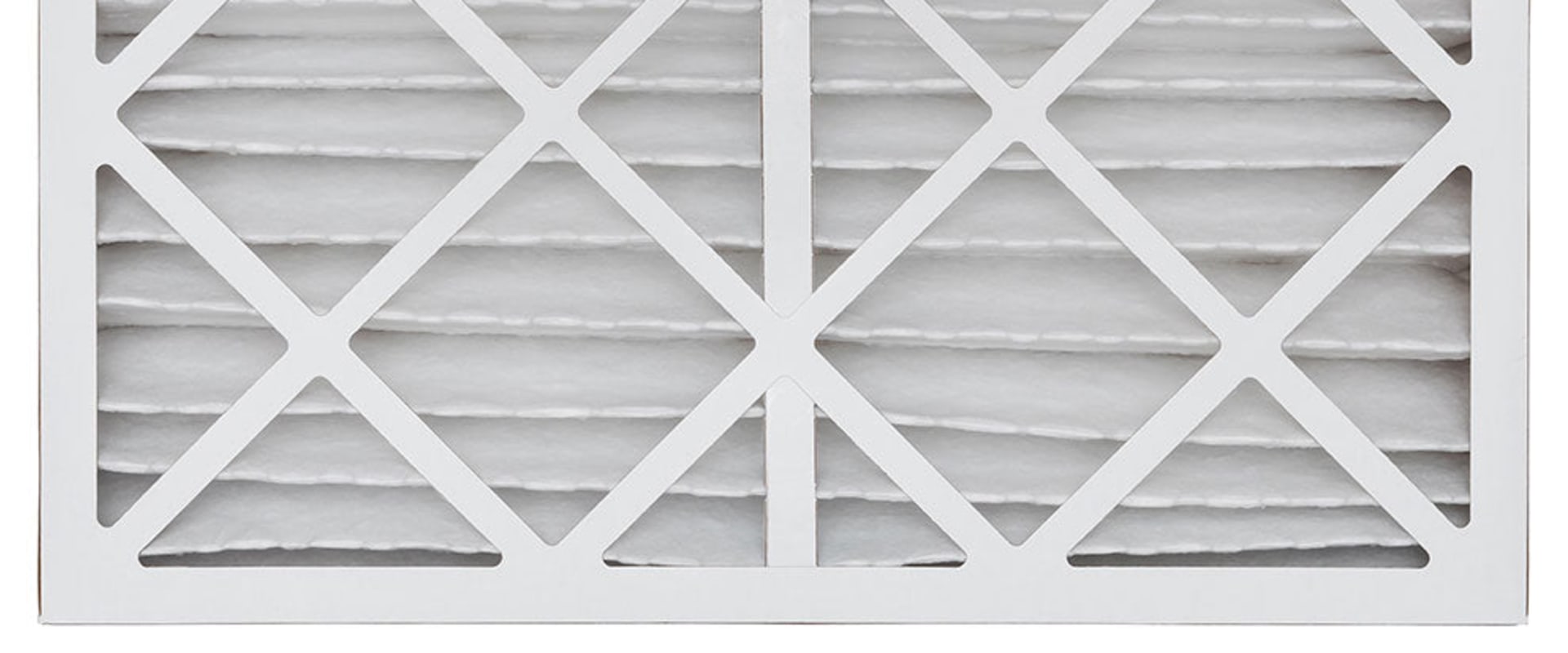
Pull a 20x32x4 in late April and you can read the season right off the pleats. That fine yellow film is pollen, and there's almost always more of it than homeowners expect. We've cut open enough loaded filters to know the calendar lies: the same filter that coasts through three easy months in fall can choke in six weeks of spring. So the real question isn't how often you should change a 20x32x4. It's what your home is asking of it right now.
TL;DR Quick Answers
20x32x4 Air Filters
A 20x32x4 is a four-inch-deep pleated HVAC filter that fits a 20x32 return and lasts longer than a thin one-inch panel. The label reads 20x32x4, but the filter actually measures close to 20 by 32 by 3.63 inches so it slides cleanly into a standard rack. We make it in three MERV ratings, and in our own testing each one pulls a different share of particles from the air.
Actual size: about 20 x 32 x 3.63 inches (nominal 20x32x4)
MERV 8 catches about 90% of common airborne particles, MERV 11 about 95%, MERV 13 about 98%
For most homes we recommend MERV 13
Replace about every 90 days, sooner with pets, allergies, or heavy runtime (roughly every six weeks in spring pollen)
The four-inch depth gives more surface area, longer life, and easier airflow than a one-inch filter
Top Takeaways
A 20x32x4 is a four-inch filter, and that depth lets it run longer than a one-inch panel between changes.
The baseline is about 90 days, but season and household routinely pull it earlier.
Spring and allergy homes: change roughly every six weeks through the pollen stretch.
Summer and winter: heavy runtime means a two to three month cadence, with monthly checks.
MERV 13 is our pick for most homes; our media catches about 98% of common airborne particles at that rating.
Season-by-Season Replacement
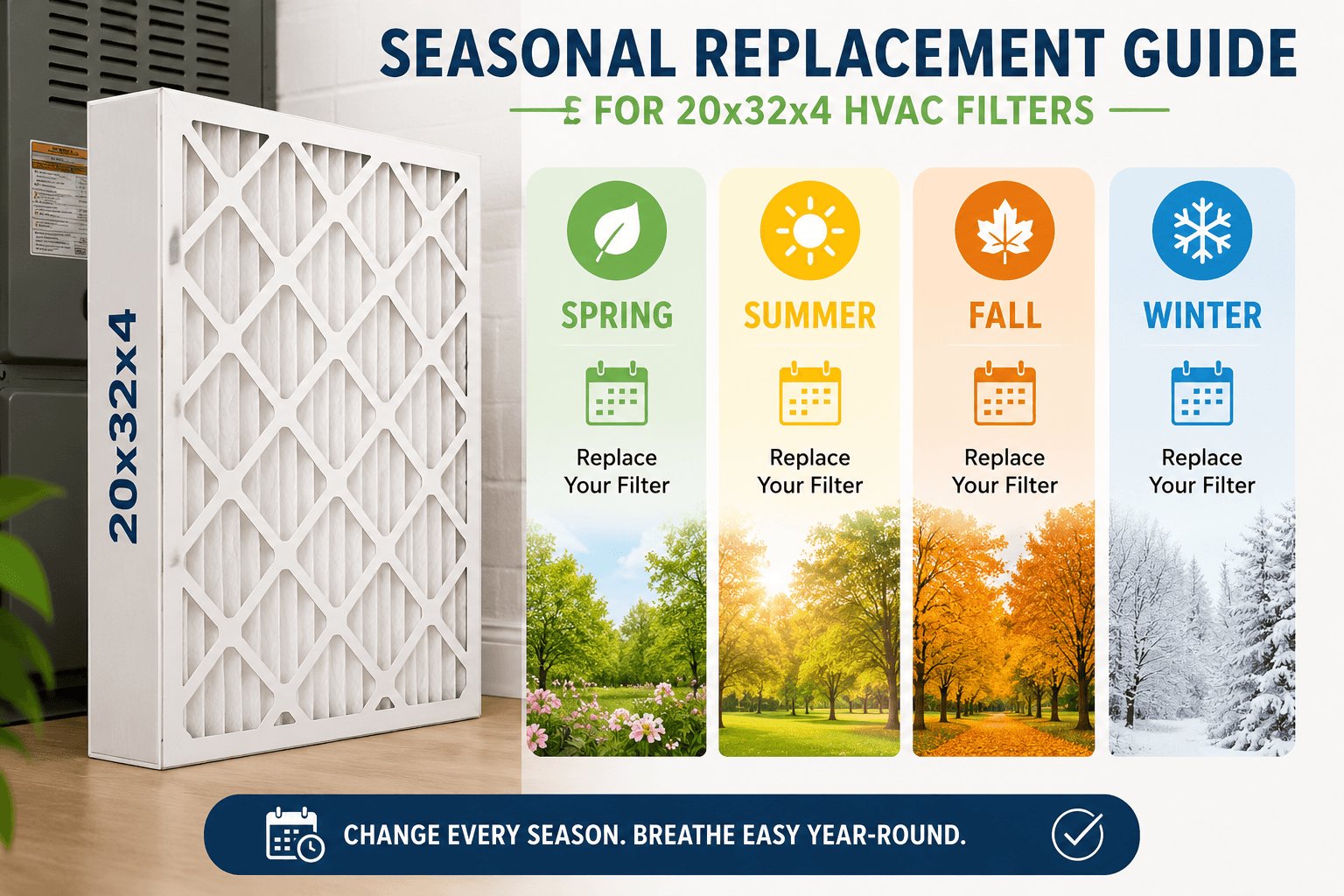
A 20x32x4 is a four-inch filter, so it carries far more pleated media than a one-inch panel. That extra surface area does the real work. It holds more dust before airflow starts to drop, which is why a four-inch filter usually runs longer between changes. One note on fit: the box reads 20x32x4, but the filter itself measures closer to 20 by 32 by 3.63 inches so it slides cleanly into a standard rack.
Spring
Spring is pollen season, and a 20x32x4 loads faster than its size suggests once the oaks and grasses start letting go. When someone in the house has allergies or asthma, we don't wait out the full 90 days. We change the filter about every six weeks through the heavy pollen stretch. A higher-rated filter pulls more of that fine pollen from the air on each pass, and that pays off most right after a run of open windows when the outdoor count climbs.
Summer
Summer pushes the system hardest. Through the hot, sticky weeks the air handler can run most of the day, and every hour it runs sends another hour of air through the filter. A loaded filter in July creates a second problem on top of dirty air. It chokes airflow and forces the blower to strain. We check a 20x32x4 monthly all summer and change it around the two to three month mark, sooner in a home that runs the system day and night.
Fall
Fall gives everything a breather. Milder weather means shorter cycles, so the filter fills slowly. We treat it as the natural reset. A fresh 20x32x4 going into the quiet season sets the system up before the heat kicks on, and the filter you pull out tells you plenty about how much dust your home really moves.
Winter
Winter seals the house up tight. Heating runtime climbs, the windows stay shut, and the same indoor air circles through the filter again and again, carrying dust, dander, and whatever a closed-up home holds onto. This is where a 20x32x4 earns its depth. We change it every two to three months through heating season and eyeball it monthly once the furnace runs daily. If you want the mechanics of how the media actually traps these particles, the overview of the air filter lays it out clearly.
Matching MERV to the Season
MERV is the number that tells you how fine a filter catches. In our own testing, our MERV 8 media pulls about 90% of common airborne particles from the air, MERV 11 about 95%, and MERV 13 about 98%. For most homes we land on MERV 13, and public-health guidance points the same way. Whatever rating your system handles best, our 20x32x4 pleated filters come in all three, so you can match the catch to whatever the season throws at your air.
“Homes built before the mid-1990s usually run on returns that were never sized for the filters people want today, so a four-inch 20x32x4 gives back the airflow a tight one-inch filter steals and still catches the fine stuff. I can tell how hard a home's pollen season hits just from how unevenly the pleats load by April.”
— Filterbuy
7 Essential Resources
EPA — Guide to Air Cleaners in the Home — Plain guidance on picking a furnace or HVAC filter and choosing a MERV rating.
EPA — Air Cleaners and Air Filters in the Home — How central HVAC filters cut indoor pollutants across a whole home.
EPA — What Is a HEPA Filter? — What MERV ratings mean and how filter efficiency gets measured.
CDC (NIOSH) — Improving Air Cleanliness — The case for upgrading central HVAC filters to MERV-13 or better where the system allows.
ENERGY STAR — Heat & Cool Efficiently — A filter-check schedule and why a clean filter protects both efficiency and the system.
U.S. Department of Energy — Air Conditioner Maintenance — Filter and coil upkeep through the cooling season.
Wikipedia — Air Filter — Background on filter types, media, and how particulate filtration works.
3 Statistics Worth Knowing
We build around how much time families spend inside. The EPA puts it near 90% of our time indoors, where some pollutant levels run two to five times higher than the air outside. (EPA, Indoor Air Quality)
A clogged filter does more than dirty the air. It drags on the whole system. ENERGY STAR points out that close to half of a home's energy goes to heating and cooling, and a dirty filter slows the airflow and makes that equipment work harder. (ENERGY STAR)
When we steer you toward MERV 13, we're echoing public-health guidance. The CDC advises upgrading central HVAC filters to MERV-13 or better wherever the system can handle it. (CDC, NIOSH)
Final Thoughts and Opinion
If we boiled all of this down to one habit, it would be this: look at your 20x32x4 once a month and let the filter, not the calendar, call the timing. The 90-day mark is a floor, not a finish line. Spring pollen and winter heating both pull it earlier, and a house with pets or allergies earlier still. Our honest take, after years of pulling these filters out of real homes, is that a four-inch 20x32x4 in MERV 13, changed on a seasonal rhythm, gives most families the best mix of clean air and easy airflow a filter can offer.
Frequently Asked Questions
How often should I change a 20x32x4 air filter?
About every 90 days as a baseline. Homes with pets, allergies, or heavy seasonal runtime do better on a 60-day or six-week schedule. Check it monthly and change it when it looks loaded.
Which MERV rating is best for allergies in a 20x32x4?
For a 20x32x4 air filter for allergies, we point to MERV 13. It catches the finest particles, including much of the pollen and dander that set off symptoms, while the four-inch frame keeps airflow easy.
Is a 4-inch 20x32x4 better than a 1-inch filter?
Usually, yes. The four-inch depth holds far more surface area, so it filters longer and strains airflow less than a one-inch filter of the same face size.
Where can I find a 20x32x4 air filter near me or nearby?
Local stock for a 20x32x4 air filter near me runs hit or miss, since it's a less common size. Ordering the size direct is the more reliable way to get a 20x32x4 air filter nearby without driving store to store.
Match Your Filter to the Season Ahead
Read your 20x32x4 against the season in front of you and the system rewards you with cleaner air and steadier airflow. Take a look at our 20x32x4 options in MERV 8, 11, and 13, and pick the rating that suits your home.
Learn more about HVAC Care from one of our HVAC solutions branches…
Filterbuy HVAC Solutions - Miami FL - Air Conditioning Service
1300 S Miami Ave Apt 4806 Miami FL 33130
(305) 306-5027
https://maps.app.goo.gl/Ci1vrL596LhvXKU79